Inspections: policy, guest link, templates
Who records the condition of the home, how the guest gets their link — once, with no automatic email — and how to frame the record with a template.
The inspection is run from the stay page, in the Guest inventory panel. Three decisions are taken there: who records, how the guest receives their link, and what gets inspected. The record you make yourself goes through StayProof instead — see StayProof: build and share the evidence.
The path, screen by screen
Choose who performs the inspection
At the top of the panel, the Who performs the inspection? card offers three policies: The host / concierge team, The guest (from their app), Guest + host co-validation. This setting belongs to the listing, not to the stay: it will hold for the next stays in the same home.
There is no save button: the choice applies as soon as you change the value, confirmed by “Inspection policy saved.”
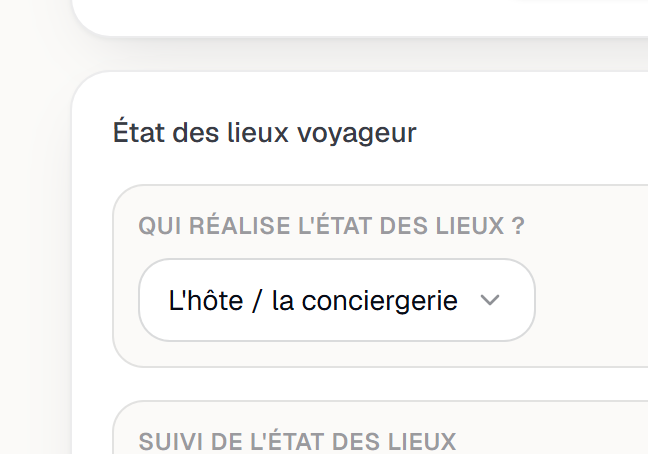
The Who performs the inspection? card and its three policies. Issue the guest link
Once the policy is on the guest or on co-validation, the Guest link block offers Generate the guest link. The link then appears in a read-only field, with Copy, the Active badge and the Revoke the link button.
You set no expiry: the dashboard offers none, and the block displays none. Validity is bounded on the platform side by the reservation — the link stops working 90 days after the check-out date, and immediately if the reservation is cancelled or marked as a no-show. The only gesture in your hands is Revoke the link.
Screenshot to be produced
captures/etats-des-lieux/02-lien-voyageur.png
Frame the record with a template
A template is the list of what has to be inspected — photos, readings, yes/no. The Inspections menu opens the Inspection templates page and its New template button; the empty page shows “No template”.
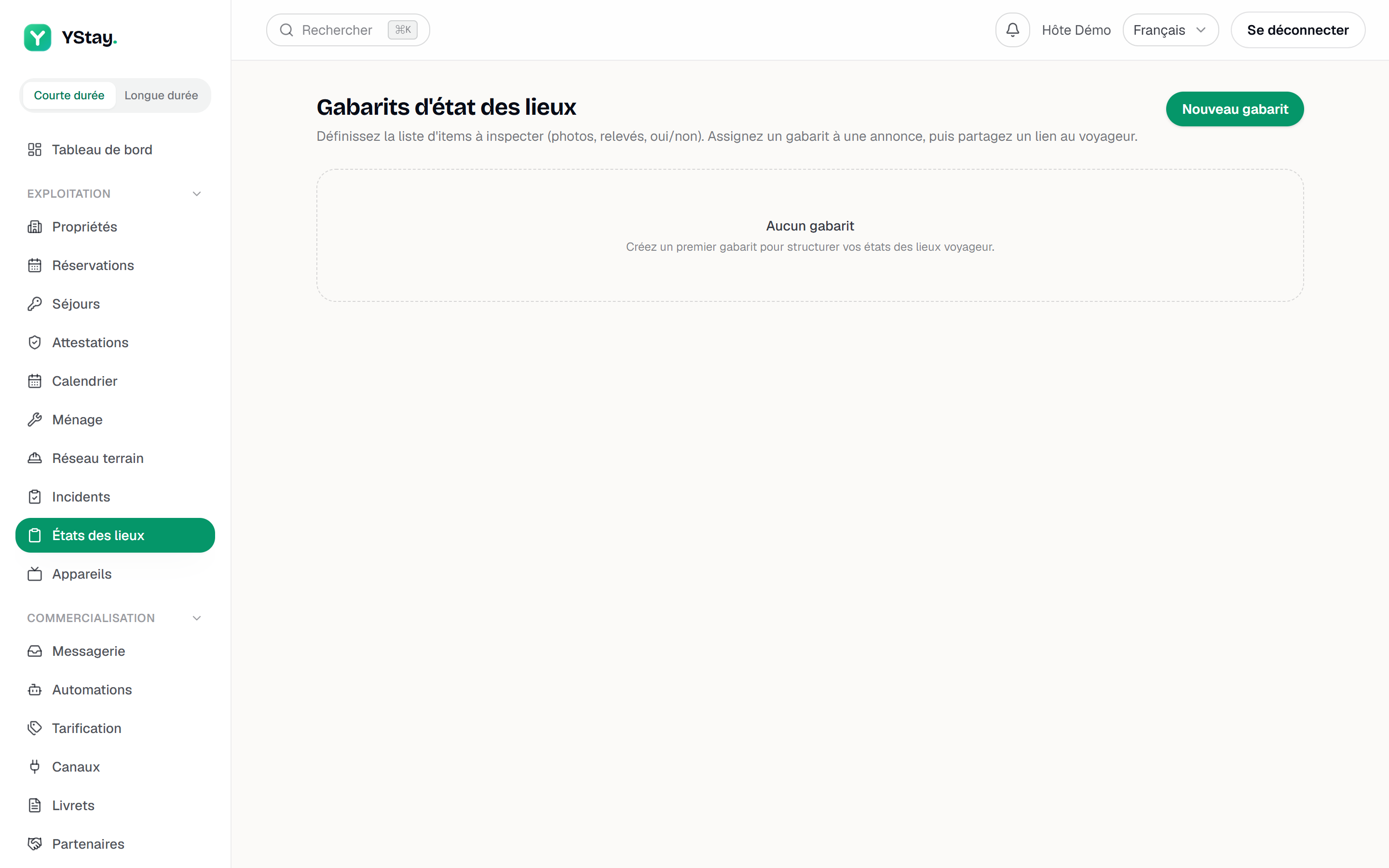
The Inspection templates page. The template is then attached to the listing from the stay page, in the Listing template block: Choose a template…, then Assign — or Detach to undo. As long as no template exists, that block points back to the templates page.
The product uses two words for the same thing here — the menu says “Inspections”, the panel says “Guest inventory”. They are the same object.
Follow the progress
The Inventory tracking block shows Entry and Exit with their state: To do, In progress, Completed, Validated or Overdue. An Evidence available badge appears as soon as the proof is built.
Two buttons sit alongside: Remind the guest, disabled while no link is active — the panel then states “Issue a guest link below to be able to send reminders.” — and Force concierge mode, which takes the record back for this stay.
Co-validate in dual mode
Under Guest + host co-validation, every inspection attested by the guest surfaces in a Co-validation required (dual mode) block, marked To co-validate, with its Reported discrepancies — or “No discrepancy reported.”
Co-validate closes the record. Reject… requires a reason, passed on to the guest: “Rejection sent — the guest will need to re-attest after correction.”
What “Overdue” actually means
The deadline is not midnight. It is computed, in the property's time zone, from the actual arrival or departure time when that is known. Failing that, it falls back on the hours announced by your listing, and as a last resort on 5 p.m. for the entry and 11 a.m. for the exit.
That deadline qualifies the inspection, not the link: it flips the tracking to Overdue and drives the automatic switch described below, but it never expires the guest link.
Next
- StayProof: build and share the evidence — the inspection you run yourself, and the package that holds up.
- Run a stay: check-in and checkout — the sessions these records belong to.
- Incidents and disputes — when a discrepancy turns into a case.
- Operations — everything about the stay and what comes after it.
Updated on