Create and publish your first guidebook
From the Welcome guidebooks page to the guest link: building a guidebook, filling it block by block, translating it, then publishing it.
The guidebook is what your guests open before they arrive and keep at hand during the stay: the Wi-Fi, the access, the times, the addresses you recommend. Filled in properly, it replaces most arrival messages — and it stays available when you are not.
This guide builds one end to end: open the Studio, lay out a structure, write blocks into it, then publish a link to send to the guest. Allow about an hour for a first honest guidebook, less if you start from a template.
The path, screen by screen
Open the Guidebooks page
In the menu, under Sales & marketing, open Guidebooks. The Welcome guidebooks page lists all your listings — one card each, with its title, a preview of its description and an Edit guidebook badge. There is nothing to create here: the list follows your listings.
If the screen shows No listings, there are none yet, and it points you to the right step: “Create a listing on a unit to attach a guidebook to it.”
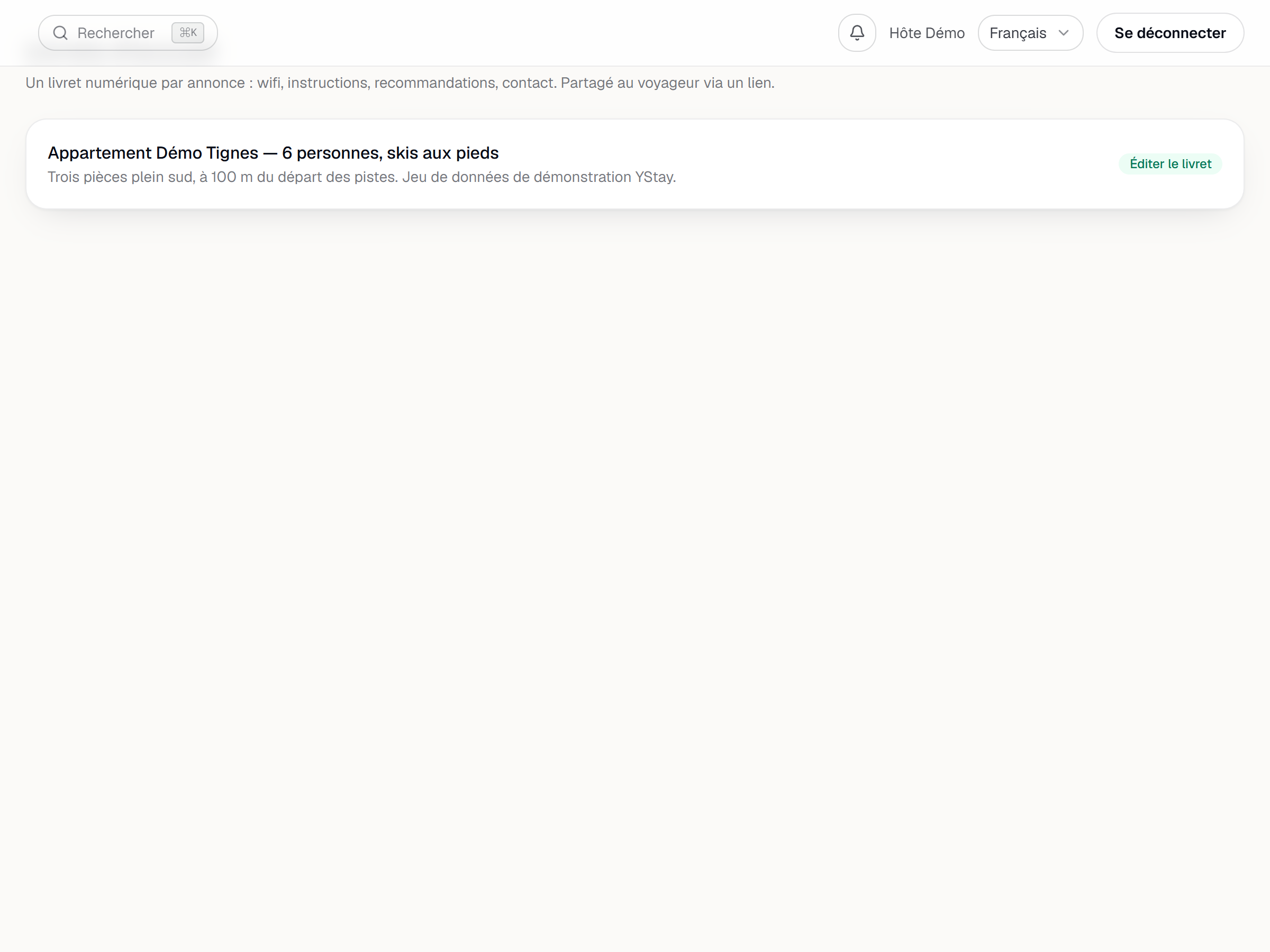
The Welcome guidebooks page: the listing card with its Edit guidebook badge. Create the guidebook
The Edit guidebook badge opens the Studio full screen. As long as the listing has no guidebook, the Studio shows Guidebook not set up yet and a single button, Create the guidebook. One click is enough: the guidebook is created empty, then the Choose a template gallery opens straight away.
Each template sets a colour mood and a starting structure; Apply installs it. You can also close the gallery and start from a blank page — it stays reachable from the Templates button in the Studio bar. One caution for later: applying a template to a guidebook that already has content asks for a confirmation, Replace content, because the existing structure goes.
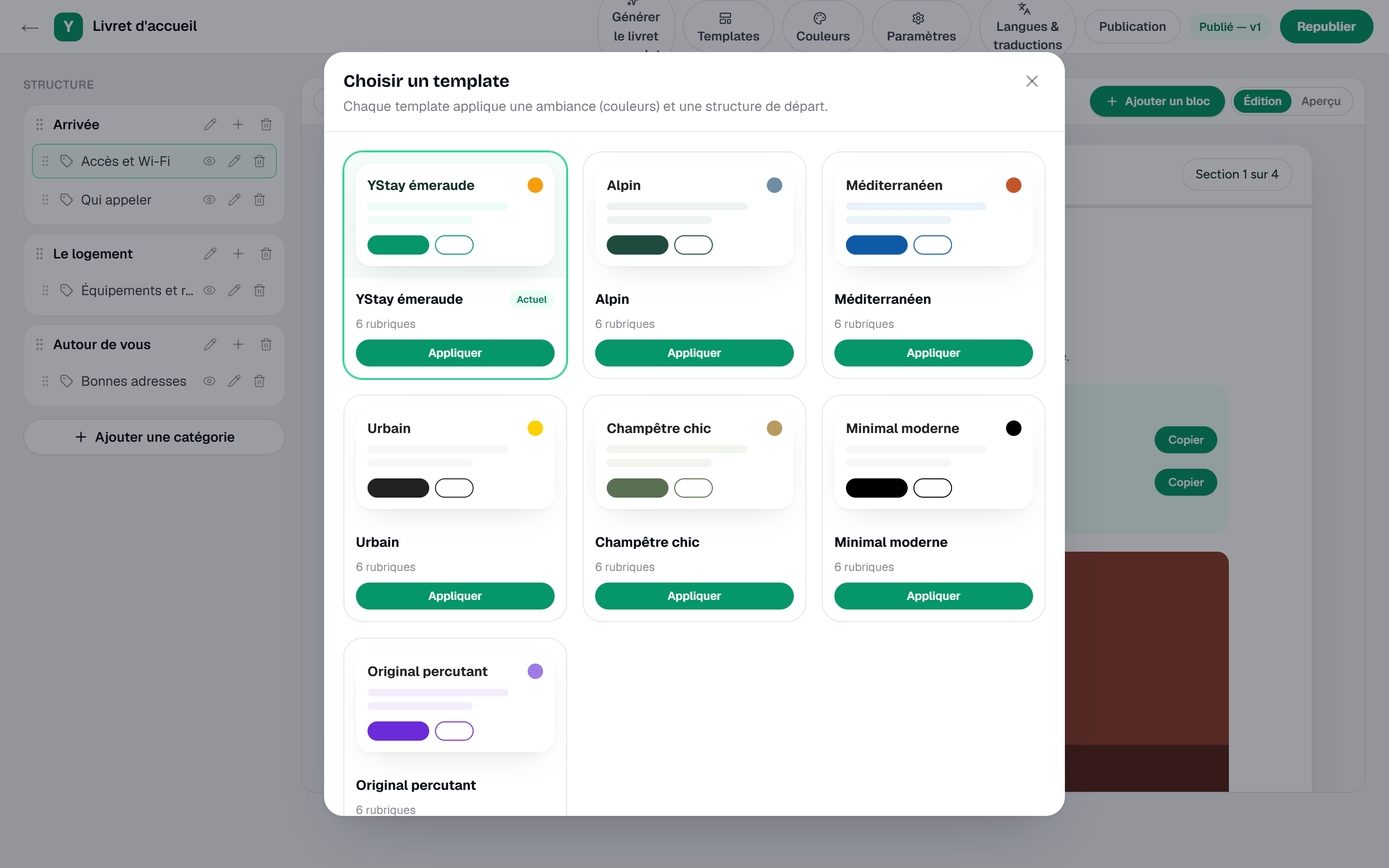
The template gallery of the guidebook Studio. Lay out the structure
The Studio reads in two columns. On the left, Structure: your categories and, under each one, its sections. Add a category and Add a section create them, names are edited in place, order is set by dragging, and an eye hides a section — it then carries the Hidden badge. On the right, the real rendering of the guest guidebook, updating as you write.
Along the top, the Studio bar lines up Generate the full guidebook, Templates, Colors, Settings, Languages & translations and Publishing, with the status badge — Never published to begin with — and the Publish guidebook button.
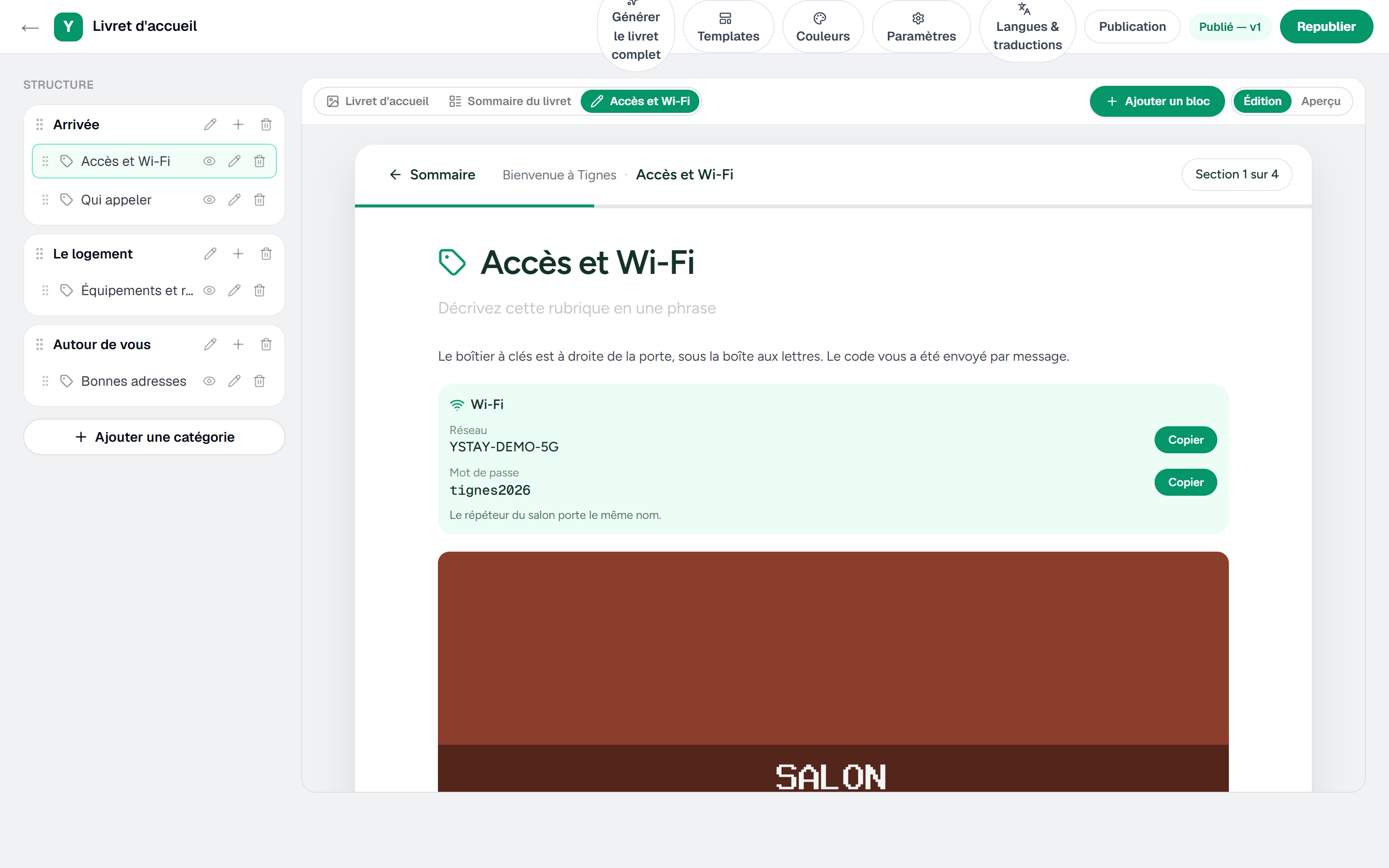
The guidebook Studio: the structure on the left, the guest rendering on the right, the toolbar on top. Fill the sections with blocks
A section is filled with blocks. Add a block opens a grid of fourteen core types: Rich text, Image, Gallery, Video, Map / directions, Contacts, Wi-Fi, Amenities, House rules, Recommendations, FAQ, Documents, Buttons / links and Table.
Titles and rich text are written straight into the rendering on the right; the other settings of a block — a map link, a Wi-Fi password, the rows of a table — open in a side panel. Nothing needs saving by hand: the bar goes through “Saving…” then “Saved”.
Image, gallery and document blocks draw from Guidebook media: Upload brings a file in, within the limits stated on screen — “JPG, PNG, WebP or HEIC images — 10 MB max.” and “PDF documents — 10 MB max.”
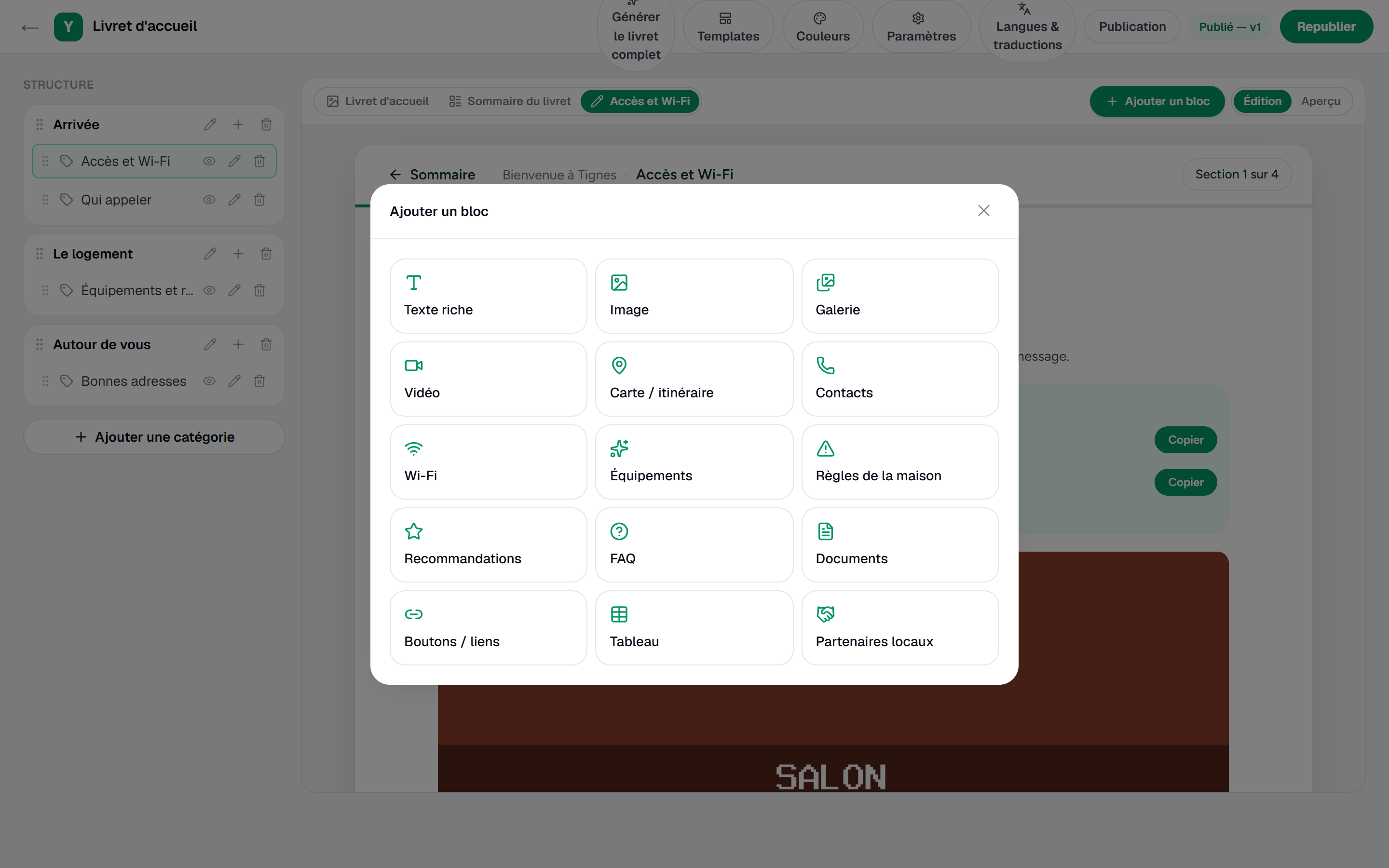
The Add a block window and its grid of block types. Translate the guidebook
Languages & translations opens the Source language and the target languages. The source language is always served to guests; switching a language on triggers the translation of the blocks, tracked in a coverage table. Switching a language off does not delete its translations: it is simply no longer offered.
Publish
Publishing opens the right-hand panel. While nothing is published it shows “No publication yet.” and reminds you: “Publish the guidebook to enable the guest link, the QR code and the PDF.” Publish guidebook then freezes a numbered version — a complete snapshot of the guidebook, carrying only the visible sections and blocks.
The panel then gives the Guest link, an address ending in
/g/…that Copy puts on your clipboard, the QR code to print in the property, and the Printable PDF in the chosen PDF language. A Version history fills in below.
The Publishing panel: guest link, QR code, PDF per language and Publish button. Check what the guest sees
Open the guest link in another tab. It is the only check that counts: the Studio shows your draft, the link shows the published version. Look there at the blocks that depend on something other than your own text, and at the language switcher if you enabled several.
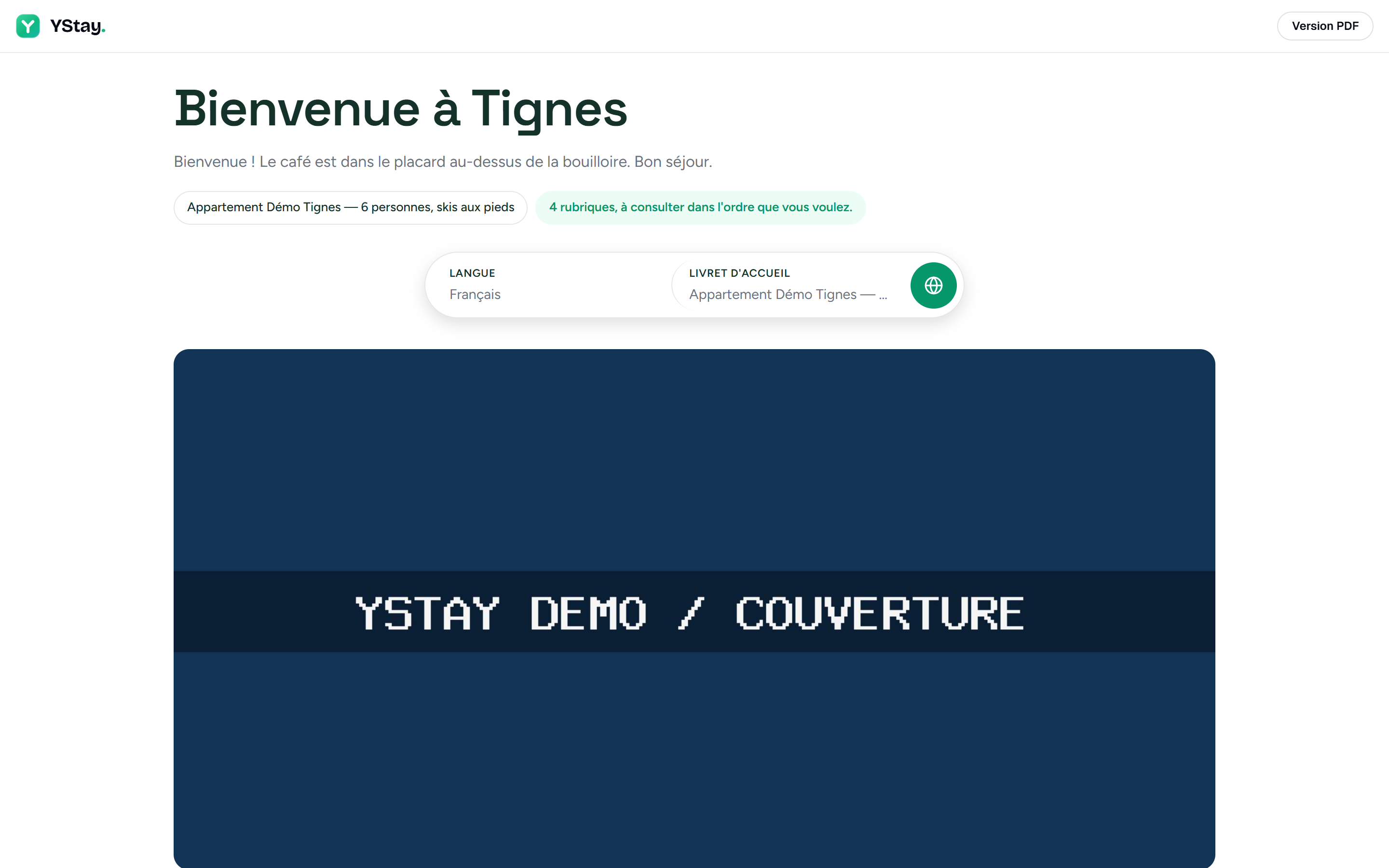
The guidebook as the guest sees it, opened through the public link.
If the guidebook does not behave as expected
- The guest link shows a page-not-found. Four causes give the same screen: never published, unpublished, a suspended account, or a guidebook withdrawn by the platform. YStay deliberately does not tell them apart — a public link must reveal nothing. Check the state under Publishing. That panel, however, knows nothing about a platform withdrawal: it keeps showing the guidebook as online. If everything looks normal there while the link stays not-found, contact support.
- A section does not appear for the guest. Only visible items go into the published version: a Hidden section or block is left out, even after republishing.
- A media file refuses to be deleted. The screen explains it: “This media is used by the published version of the guidebook: republish without it before deleting.” Remove it from the blocks, republish, then delete.
- The PDF does not show your latest corrections. It is rendered “from the latest published version, in the chosen language” — republish first, reopen afterwards.
Next
- Take your first reservation and manage your calendar — the stay this guidebook will be handed to.
- Connect a lock and give guests access — the access the guidebook announces but does not manage.
- Guidebooks — what a guidebook covers, section by section.
- Install a TV and pair it with your account — show this guidebook on a screen inside the unit.
- List a partner and run their insert — the addresses you recommend, this time on the local-partner side.
Updated on