Description, amenities and listing score
Writing the four description sections, ticking amenities, and reading the score that follows — including what AI does there, and what it does not.
Three cards on the listing page answer each other. Description and Amenities are what you fill in; Listing score, at the top of the page, is what YStay derives from it. The score is not an opinion: it is a calculation, and this guide explains which one.
Fill in the content, then read the score
Read the Listing score panel
The gauge shows your score out of 100, doubled by a band badge. Below it, the four dimensions each show the points earned out of the points available, with a coloured dot: this is where what costs the most is visible at a glance.
As long as the listing is neither published nor connected to a channel, the Distribution dimension is set aside and its weight is spread over the other three. A message says so under the gauge: “Distribution isn't counted yet: publish and connect the listing to include it.”
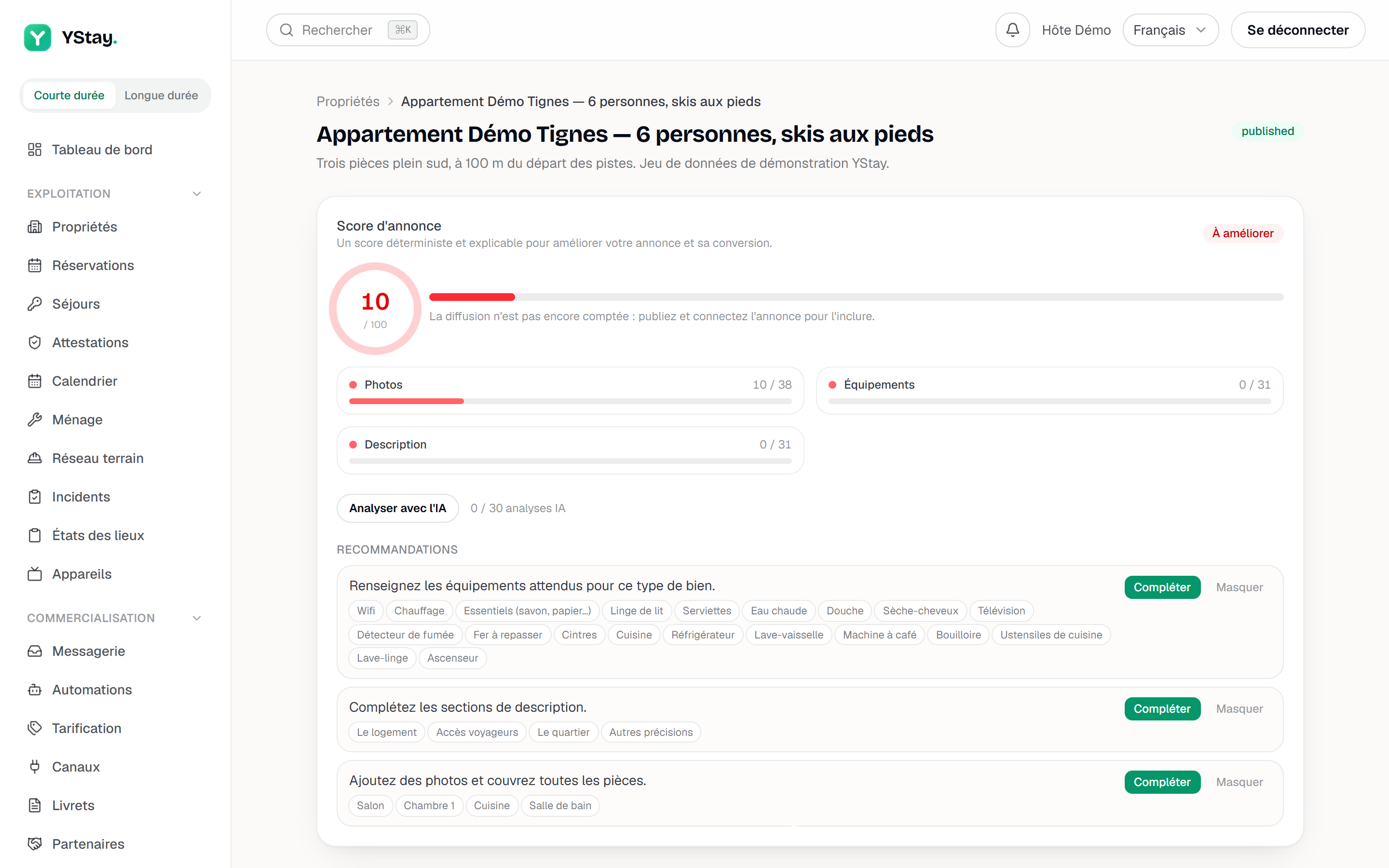
The Listing score panel: gauge, dimensions and recommendations. Write the four description sections
The Description card does not ask for one text, but four: The space, Guest access, The neighborhood and Other things to note. Each is capped at 2,000 characters, with a live counter under the field.
The editor accepts light formatting — bold, italic, lists, small heading — with a preview view and a code view. On save, the public page switches to that rendering: what you see in the preview is what the traveller will read. Save confirms with “Description saved.”
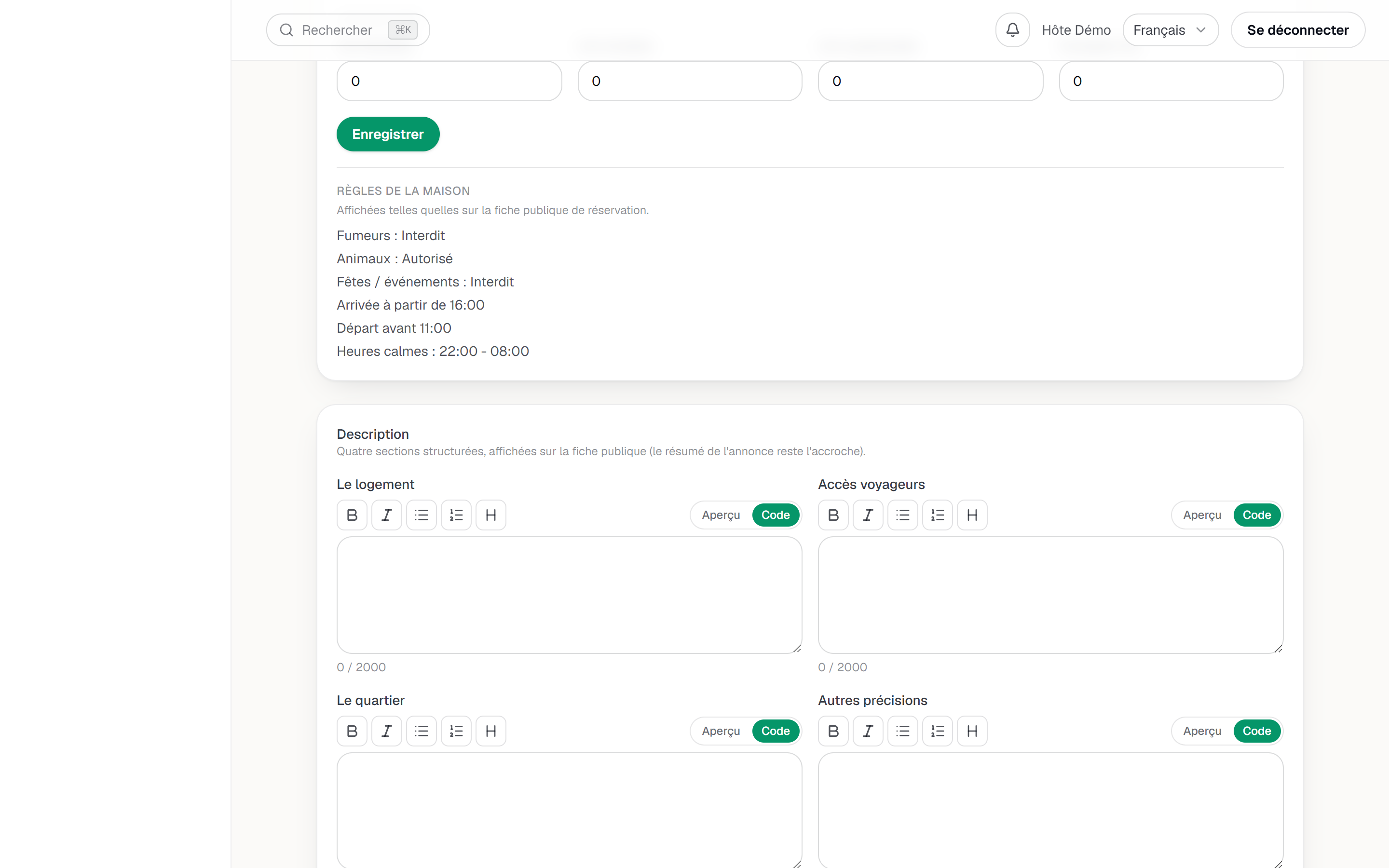
The description card: the four structured sections. Tick the amenities
The Amenities card groups the YStay catalogue into eight collapsible categories — Kitchen, Bathroom, Bedroom, Outdoor, Comfort, Safety, Family, Workspace. Each header shows how many items are ticked out of the total, and a selection counter sits at the top of the card.
A ticked amenity opens a Note (optional) field, capped at 120 characters: this is where the useful nuances go, along the lines of “Pool heated May–Sept”.
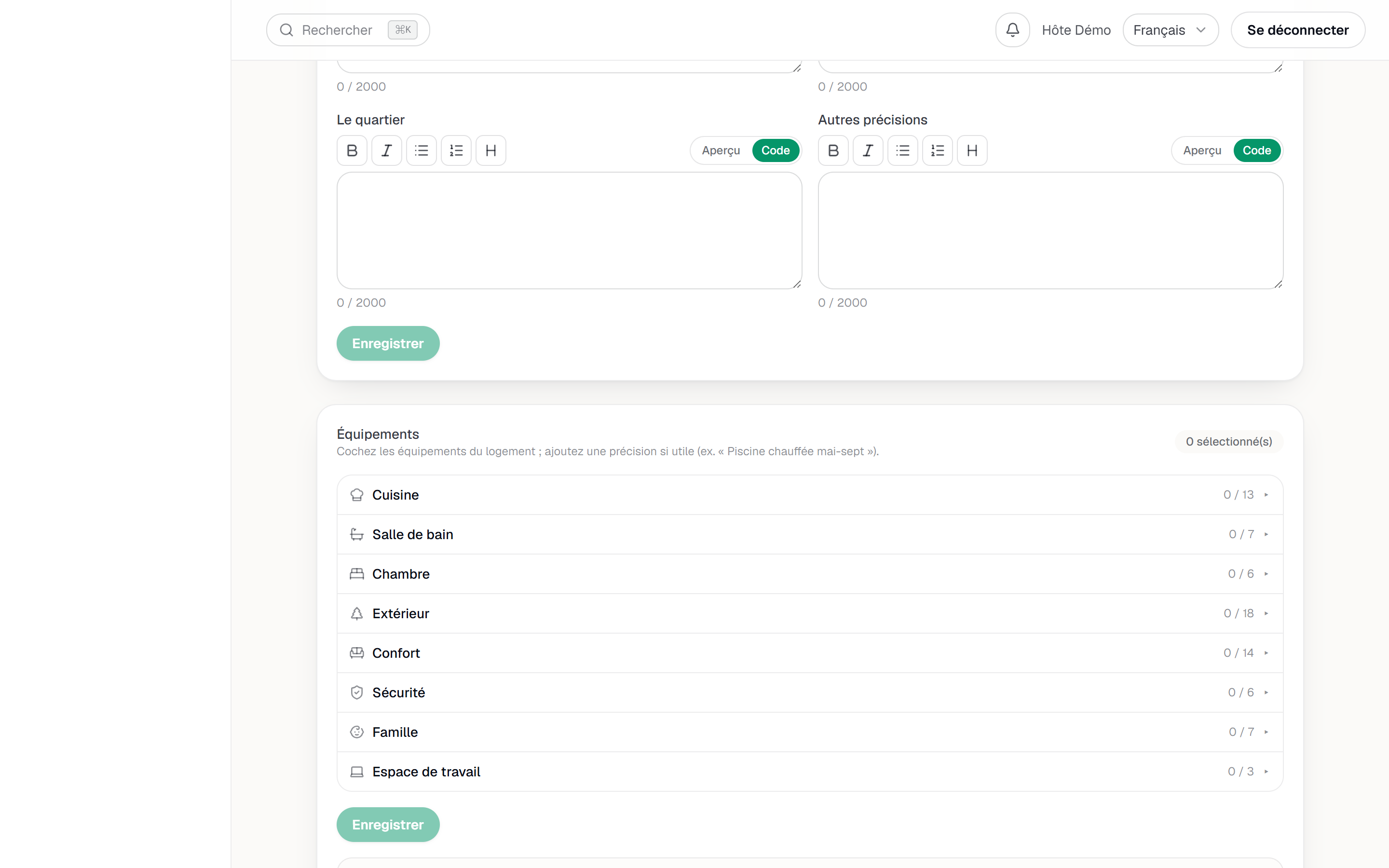
The Amenities card expanded: catalogue and custom entries. Add amenities of your own
Under the catalogue, the My amenities block belongs to your account, not to this listing: “Create your own amenities and categories: they become selectable on all your listings.” A name, a category, Add amenity — and you can create your own categories too.
What you create can be renamed in place and deleted there, with a mention of how many listings use it. The YStay catalogue's own amenities do not appear in that block: they cannot be deleted, only ticked or left alone.
Work through the recommendations
Under the score, each gap becomes a line under Recommendations, with chips naming exactly what is missing — a photo zone, an expected amenity, a description section. The Complete button takes you straight down to the card concerned.
Hide sets aside a recommendation whose trade-off you accept; a count of hidden recommendations lets you Show again. That hiding lives in your browser, not in the listing: it follows neither your teammate nor your other machine.
Ask AI for a rewording
Analyze with AI takes the same recommendations and rewrites each as one actionable sentence; the lines concerned then carry the AI mark. Once done, the analysis can be run again with Re-run AI analysis.
What reaches the model is narrow: the listing title, its property type, the score and the recommendation keys. Neither your photos nor the text of your description are sent.
House rules, read-only
The The space card ends with a House rules block — smoking, pets, parties, arrival and departure times, quiet hours — with the note “Shown as-is on the public booking page.”
Next
- Listing photos and zones — the heaviest dimension of the score.
- Translate and distribute the listing — the Distribution dimension, once the listing is published.
- Set your rates — the other publication requirement.
Updated on