Create and publish a contract template
From a template built on the YStay library to a contract signed by the guest: the Studio, the no-legal-advice checkbox, and what confirming a direct reservation sets off.
YStay produces your seasonal rental contracts from templates you compose yourself: one template published once and for all, then contracts generated automatically, reservation after reservation. The Seasonal contracts page gathers the Templates, Generated contracts, Per-property overrides and Landlord signature tabs.
Composing and publishing a template
Create a template from the library
Open the Templates tab, then Create a template. The New contract template window asks for a name, then offers Start from the YStay library: that option copies the 17 reference clauses, all editable afterwards.
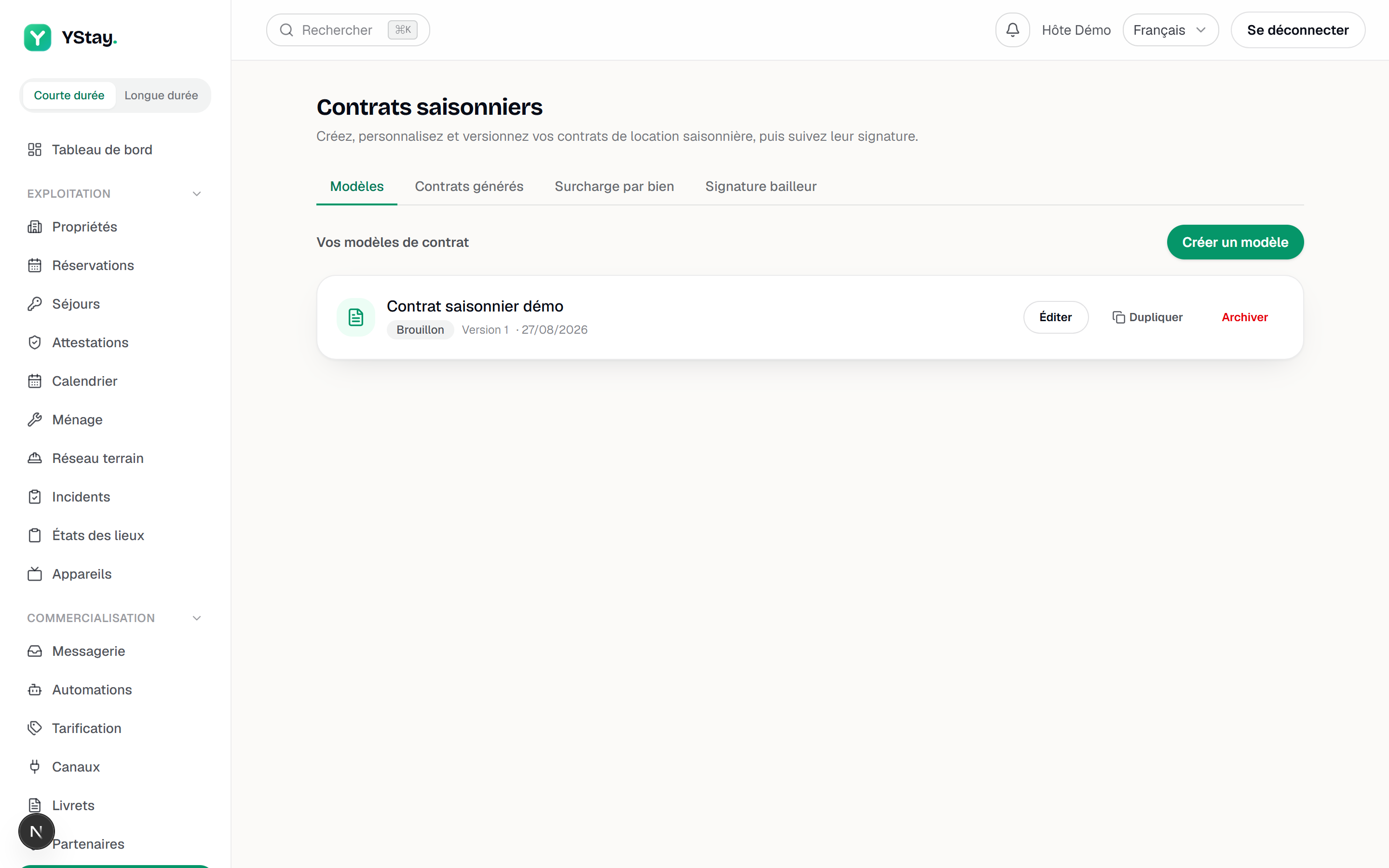
The Templates tab and the creation from the YStay library. Edit the template in the Studio
Edit opens the Studio full screen. It is not a form: it is the document itself, in A4, exactly as it will be printed. Click an article to edit it in place; the side Clauses rail enables, reorders, adds and deletes articles — except those marked Mandatory, which are locked. The Paper button applies a style to the document source: the canvas and the PDF preview move together.
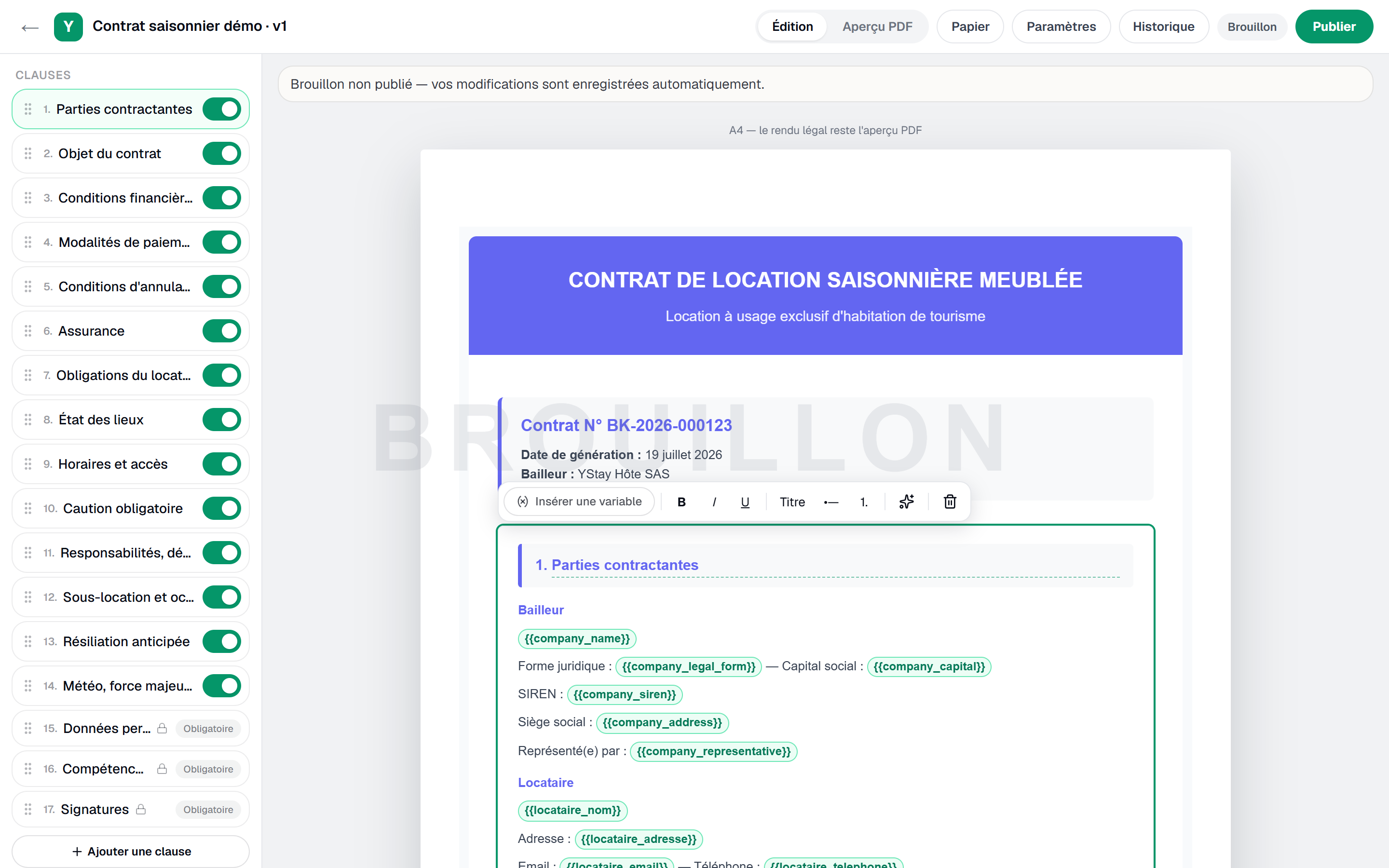
The contract Studio: the paper canvas and the clause rail. Insert dynamic fields
Insert variable opens the catalogue of fields filled in at generation time, grouped under Host / Landlord, Property, Guest, Stay, Financial, Pricing option, Settings and Signature. That catalogue is closed: the server refuses to save a clause holding a variable it does not know, and tells you which one to fix. Inventing a field name gets you nowhere.
Store your landlord signature
In the Landlord signature tab, draw your signature or upload an image. It is then applied to every generated contract before it is sent; without it, the contract goes out unsigned on your side.
Publish the template
Publish opens the Publish the template window: the no-legal-advice notice, then a mandatory checkbox — “I understand that YStay does not provide legal advice and that I am solely responsible for my contract and my rental.” Until it is ticked, the Publish button stays disabled, and consent is asked again every time the window is opened. Publishing freezes the version read-only, so it must be duplicated to be changed. Set as default template extends it to all your properties.
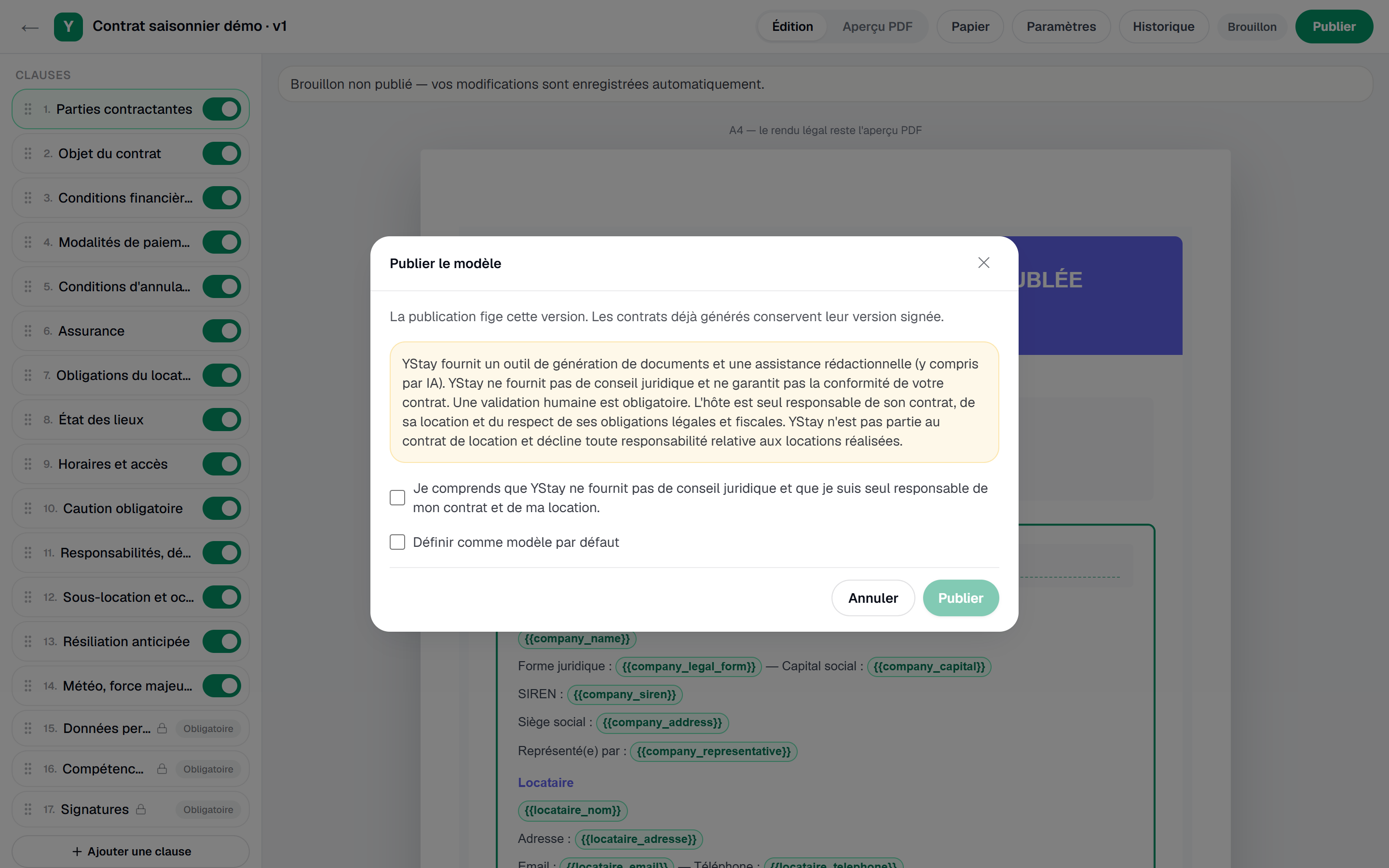
The publication step and its no-legal-advice checkbox. Override one property, if needed
In the Per-property overrides tab, pick a property, then a Base template among your published templates, and override values and clause texts without touching the original. An attached template that stops being published falls back on your default.
Generation, on confirming a direct reservation
There is nothing left to trigger: as soon as a direct reservation moves to Confirmed, YStay composes the contract from the property's effective template, applies your signature and makes it available to the guest — in the background, and one reservation never ends up with two contracts. With no published template, generation does not fail for all that: YStay falls back on a standby contract, a spare wheel rather than a destination.
Following your generated contracts
The Generated contracts tab lists contracts and their status: Generated, Sent, Signed, with two exits, Failed and Cancelled. A contract's page offers the Source PDF, the Signed PDF once the signature is in, and the Signature evidence. Three actions live there, each under a condition: Regenerate only applies to a contract in Failed; Resend link chases the guest once and once only, after which the screen shows Link already resent; Cancel contract requires the reservation itself to be cancelled or a no-show.
The guest's signature
The guest signs from their direct stay space, with no account to create: they re-read the contract, enter their full name, draw their signature, accept the simple electronic signature notice, then receive a six-digit code valid for ten minutes — five failed attempts lock the signature temporarily. That simple electronic signature is implemented by YStay, with no third-party provider: one-time code, drawing, timestamp and IP address make up the evidence, and the signed document is sealed. The request screen mentions email only; an SMS also goes out when the guest's phone number is known.
Next
- Contracts — the rest of the section, and what becomes of a signed contract.
- Take your first reservation and run your calendar — the confirmation that sets it off.
Updated on